
Interview with Tati Lopatiuk, creator of the Fanfic Workshop at FLIMO - Mauro de Oliveira Literary Festival 2018

Updated: Apr 26
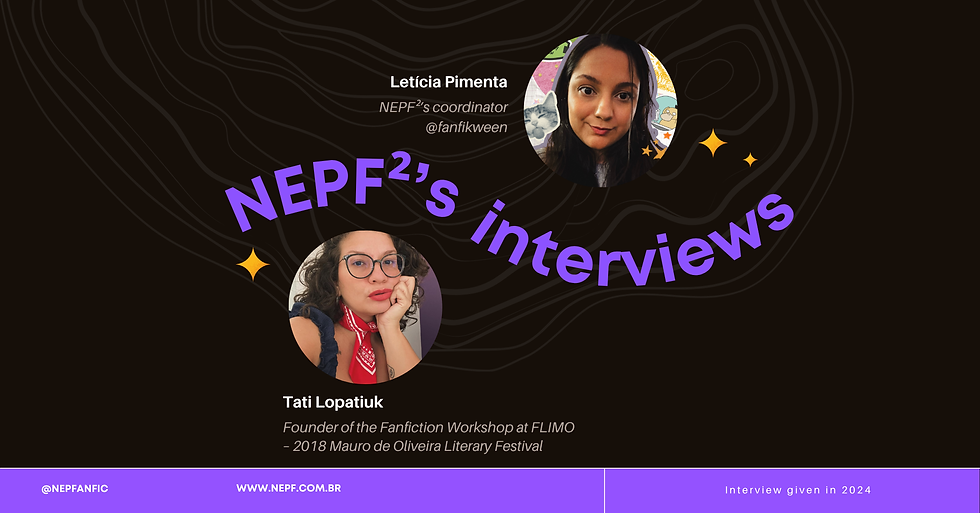
Tati Lopatiuk is a publicist and writer that, in September 2018, held a Fanfics workshop at FLIMO - Mauro de Oliveira Literary Festival at the Professor Mauro de Oliveira State School in São Paulo, where she managed, through this event, to open up space for fanfics in public schools.
Like Tati, we at NEPF have the premise of taking fanfic everywhere, and schools are the places where we should most encourage reading and using our imaginations. That’s why we invited Tati to answer a few questions about the workshop and the importance of fanfic for the development of future writers.
#1 - First of all, thank you so much for agreeing to take part in this interview, Tati! Tell us a bit about yourself, where you’re from and what you work with.
Thank you! My name is Tati Lopatiuk, I’m 39 and I work in publicity. I was born in Paraná and moved to São Paulo at the age of 25, where I’ve lived ever since. I’m a copywriter by vocation, and I currently work as a Content Manager at a multinational agency. I’ve been married for 13 years and have 3 pet cats.
#2 - How did you get to know fanfics? Tell us a little about your experience with them and how they have shaped you to this day.
As someone who has read a lot since I was a child, I have always explored all the literary genres available to me. With the internet, I came into contact with fanfiction when I started liking One Direction. Until then, I didn’t write fiction, I just had my blog where I wrote prose about everyday topics. It wasn’t until 2014 that I wrote my first piece of fiction, a fanfic about Daniel Johns (lead singer of the band Silverchair). As it was a relative success on the platform where it was published, Wattpad, I began to exercise my creativity more in this direction and never stopped writing. Today I write regular novels and fanfics too, mainly involving footballers. I have 16 independently published books, 5 of which are fanfics. I still consume a lot of the genre, as well as many others I like to read, such as romance, biographies and suspense.
#3 - For you, is fanfic an important gateway to the development of writing for future authors?
Fanfic is very interesting for those who are starting to write because it allows you to start from a safe place: an idol or fictional character that you already “know”. Much of the difficulty in writing a story comes from having to create it from scratch, and with fanfic you’re already starting from a point, as you have more context for the main characters. What’s more, the plots of fanfics are closer to our everyday daydreams when it comes to the fan relationship: dreaming of being close, living a story with that idol. All of this makes writing fanfic relatively easier, and so it becomes a valuable tool, because once you realize that you can write a story, you feel encouraged to produce more and more. In this way, you improve with each new fanfic, which makes it possible to grow and try different genres and approaches that seemed impossible before.
#4 - We heard that you produced a fanfiction workshop, what was the process for this workshop and where did it take place? Give us the details!
In September 2018, I gave a fanfic workshop to the students of the Professor Mauro de Oliveira State School, on the west side of the city of São Paulo, during FLIMO - Mauro de Oliveira Literary Festival. The invitation came from the event’s organizers, who wanted the students to expand their knowledge of literature not only as readers, but as authors themselves. The workshop lasted about three hours, and based on the motto “write yourself the book you want to read”, I worked with the students on the historical context of the genre, bringing examples of famous fanfics, including those that weren’t even seen as such, I brought some writing tips, we talked about publishing platforms and, finally, we ended with a short exercise where each student wrote a long synopsis of the fanfic they intended to write (or were already writing). We finished by reading these synopses together and giving our perceptions of the positive points and points for improvement in these students’ projects.
#5 - How receptive were the students to the workshop? And the teachers?
It was a very warm, interested and participative class.The fanfic workshop was the first to sell out as soon as registration opened, and many students told me that they “couldn’t believe” that the school would bring in something on the subject, which they thought of as something “all their own”.All the students did the final exercise, leaving with a start on a book, which left them feeling very motivated and valued.The teaching staff were very pleased to see that they had “got it right” by believing in the theme, both because of the high level of support from the students and because of their happiness at having the space to talk about their dreams and their idols.
#6 - Do you think this experience has had any impact on the school environment and the lives of these students?
I think so. For me, the main feeling I got from them was one of validation. The topic of fanfiction wasn’t new to any of them there; on the contrary, they wanted to take part precisely in order to get tips on how to start producing or improve the production already underway. I felt it was something collaborative, a moment when we created together, and that made them feel important. After all, it was an adult author talking to them as equals, exchanging experiences and showing that there is value in what they were doing. We all left very happy and inspired.
#7 - What did this experience mean to you?
For me, it was a very interesting exchange and a reaffirmation of the value of literature in my life. It’s very meaningful to be able to talk about what moves us and to see that our little solitary world that exists while we’re writing is something much bigger, that many people are experiencing it too, and that, even though we’re each in our own corner, together we’re creating something.
#8 - What tips would you give to other people and/or other universities who want to run fanfic workshops?
It’s worth keeping an eye on the prominent profiles on fanfic platforms to discover new talents who can pass on their experience with the genre.In fact, it’s possible to find these people even within the university, so it’s always good to start from the point of view that it’s a subject that’s already part of these young people’s daily lives.
#9 - Finally, please leave us your comments about our hub and our blog readers!
I’m very happy to know that there are centers like this within universities, it’s essential to understand that fanfic is a literary genre as valid as any other. The fact that fanfic is more accessible, both in terms of consumption and its own production, needs to be seen as a potential, and not as a demerit, as we so often see it out there. All in all, thank you for the space and I hope this initiative grows more and more. There will always be an audience, I guarantee that!
Link to Tati’s profile on Instagram: @tadsh
Comments